Why the Flat Below Hears Your Deadlift
 7 min read
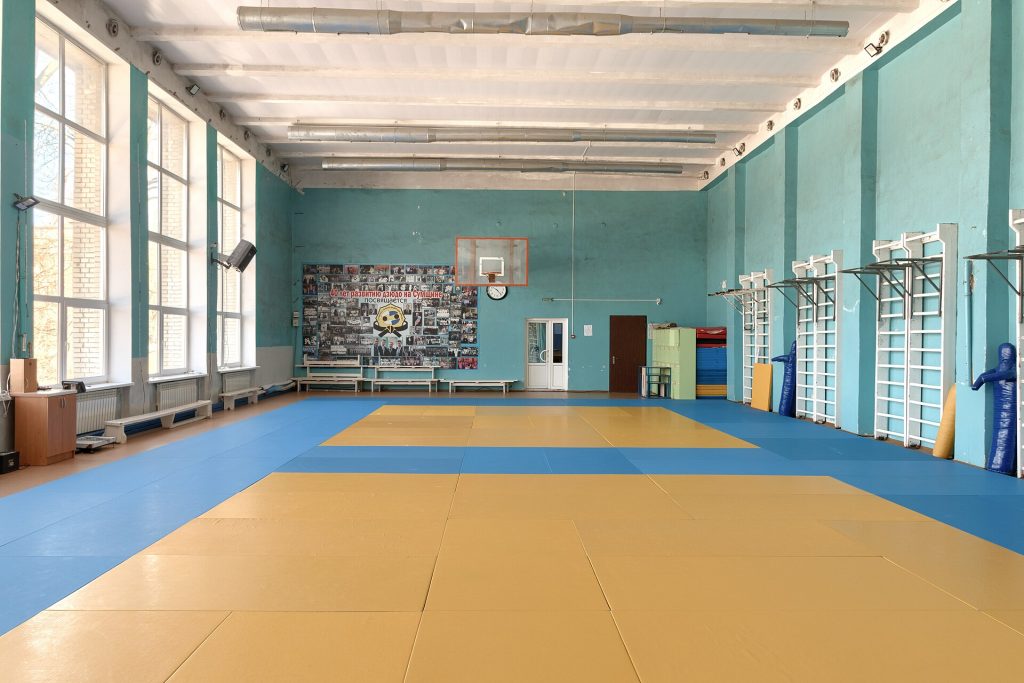
A thick mat does not stop noise reaching the flat below, though that is what most mats are sold to do. The path that matters runs through the structure rather than the air, and a mat only touches one end of that path.
Two mechanisms are involved. Airborne sound is what you hear directly, and structure-borne sound is vibration entering the building and radiating from surfaces elsewhere, which is why a deadlift can sound like a slammed door two floors away.
The levers are mass, decoupling, drop height and timing, and each one changes a different part of the chain. Knowing which part you are changing is the difference between spending money and solving anything.
Two Paths for the Same Event
When a loaded bar meets the floor, some energy becomes noise in the room and the rest enters the slab as vibration. The first part is what a mat addresses, and it is usually the smaller share of the problem in a building with a hard floor.
Vibration travels through structure with very little loss, and it radiates from any large surface it reaches: the ceiling below, a wall, a radiator pipe. That is why the sound downstairs seems to come from the wrong direction and why treating the gym floor alone rarely satisfies anyone.
The two paths need different fixes. Absorbing airborne noise is a matter of soft surfaces and sealing gaps, while interrupting structure-borne vibration requires a break in the transmission path, which is a construction detail rather than a purchase.
Mass, Stiffness and the Drop
A floor’s response to impact depends on mass and stiffness together. A heavy concrete slab resists movement and radiates little; a timber deck flexes, stores energy and gives it back as sound, which is why an old building carries impact further than a new one.
Adding mass helps, and it is the cheapest intervention available: more plates on the bar, a heavier platform, a denser mat. None of these decouples anything, but each reduces how much the floor moves for a given impact.
Stiffness is harder to change. A joist span that flexes under a dropped 100 kg will keep flexing no matter what lies on top of it, and the only real options are spreading load across more joists or avoiding the drop altogether.
What Mats Actually Do
A 15 mm rubber mat compresses by a millimetre or two under a dropped bar, which absorbs a small fraction of the energy and slightly lengthens the impact. That is audible as a duller thud and measurable as a few decibels, not as silence.
The mat’s larger effect is on the bar and the floor. It prevents chipping, spreads the contact patch and stops the bar from ringing, which is the high-frequency part of the noise that people find most irritating.
Thicker is not automatically better. A soft 40 mm tile lets plates sink and the bar bounce unpredictably, and a lifter who cannot trust the floor will start lowering the bar instead of dropping it, which changes the training.
Decoupling as the Real Fix
Decoupling means putting a resilient layer between the impacting mass and the structure, so that vibration meets a material that converts it to heat instead of passing it on. Rubber crumb, cork and purpose-made isolation pads all do this to some degree.
A working platform usually combines layers: a stiff top surface to spread load, a resilient layer beneath it, and a gap or a soft bearing at the edges so the platform does not touch the walls. The edges are where most home-built versions fail.
The cost is height, typically 100 to 150 mm, and a loss of stability if the resilient layer is too soft. A platform that bounces under a squat is worse than a mat that transmits noise, because it changes the lift itself.
Bar Type and Drop Height
Bumper plates exist to be dropped, and they spread impact over a few milliseconds rather than a fraction of one. Iron plates on a hard floor produce a sharp transient that carries further through structure than the same weight in bumper plates.
Drop height matters more than most people expect, because energy rises with the square of velocity. Dropping from lockout instead of from the hips roughly doubles the impact, and controlling the descent to knee height cuts it by more than any mat can.
The practical consequence is that technique is a noise decision. A lifter who lowers the bar under control for most reps and drops only the last one produces far less disturbance than one who drops every rep from the top.
Building Type Sets the Limit
A ground-floor concrete slab has almost no path to a neighbour, so the problem reduces to noise in the room itself. A timber-framed upper floor is the opposite case, and no mat solves it completely because the structure is the transmitter.
Between those extremes sit converted buildings, where a screed over timber or a floating floor may or may not be continuous between flats. Knowing which you have is worth more than any product, and it usually requires asking the building rather than guessing.
The type of building also decides who to consult. A concrete structure with separate slabs has almost no shared path, while a timber frame with continuous joists shares every impact, and the second case is where a structural opinion is worth paying for.
Timing and the Social Layer
Noise complaints are rarely about a single event. They are about repetition at times when the listener cannot escape it, which is why a twenty-minute session at eight in the evening causes more friction than an hour at midday.
Telling a neighbour what you are doing and when changes the calculation on their side. Most people tolerate a predictable noise far better than an unexplained one, and a warning costs nothing that a mat costs a great deal for.
The Cheap Experiment
Before building anything, it is worth establishing how bad the problem actually is. A helper in the room below, a phone recording on the floor, and a controlled drop from knee height will tell you more about the transmission path than any product description or published rating.
The recording matters because perception is unreliable across a wall. A sound that seems tolerable in the gym can arrive downstairs as a low-frequency thump, and low frequencies are the ones that travel furthest through structure and annoy a listener for longest.
Repeating the test after each change, from the same height and in the same position, is the only way to know whether a mat, a platform or a change in technique achieved anything. Without a baseline, every purchase feels like an improvement and none of them can be compared.
Where This Leads
Noise and flooring are usually solved together, since the surface that protects the slab is also the first layer of any decoupling scheme. Choosing it for one job and hoping it does the other is how rooms get rebuilt twice.
The remaining variable is the equipment itself. Bumper plates, a bar with a dead bounce and a platform built to take drops are a system, and treating them as separate purchases tends to produce a room that is loud in a way nobody can quite locate.