Battle Ropes: Trading Space, Length, and Anchoring Options
 7 min read
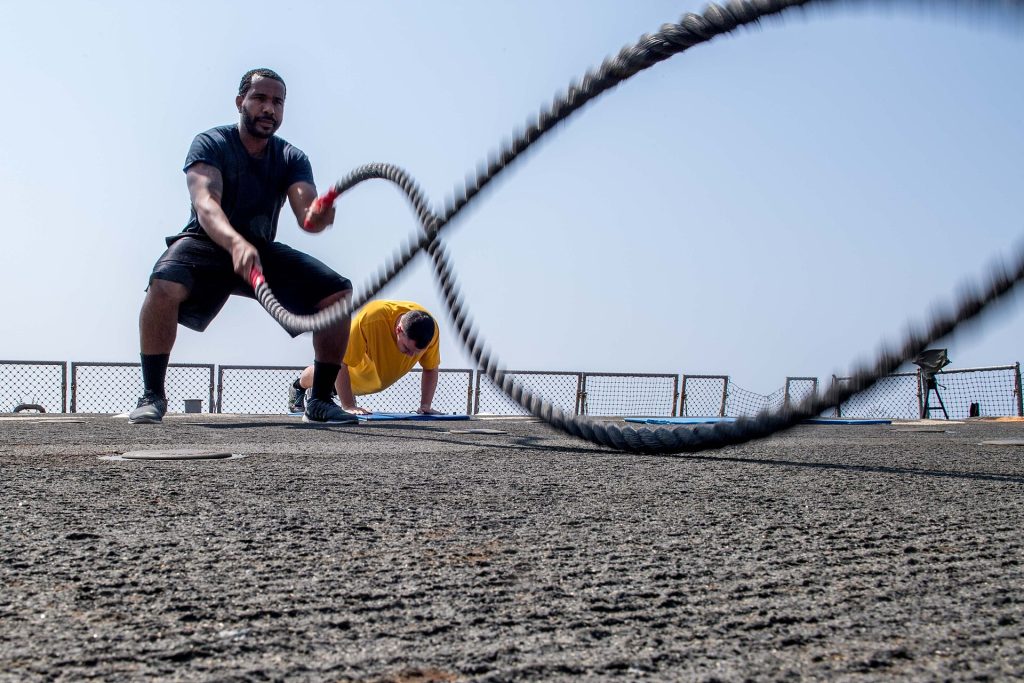
Longer ropes are not harder, although the assumption that more rope means more work is what sells the 15 m version to people with a 4 m room. Length changes the wave, and the wave is what produces the load, so a rope that is too long for the space produces less work rather than more.
A battle rope session is a loop of heavy cord anchored at one end and driven by the hands at the other. Everything about the training effect follows from how far the wave has to travel, how much mass it carries, and whether the anchor stays put when you pull.
Those three variables interact with room dimensions more than with fitness, which is why the equipment choice should start with a tape measure rather than a training goal.
Length and the Wave You Can Drive
A wave travels from the hands toward the anchor, and it loses amplitude as it goes. With a short rope the wave reaches the anchor while still large, so the cord stays in motion and the hands keep working against its momentum.
With a long rope in a short space, the wave never develops, the middle of the cord drags, and the movement becomes an arm swing rather than a wave. That is why a 9 m rope in a 3 m room feels easier than a 6 m rope in the same room, despite weighing more.
The rough rule is that you need at least half the rope’s length in clear floor space, plus room to stand back. Anything less and the excess cord piles at the anchor and stops participating.
Diameter and Weight per Metre
Diameter sets mass per metre, and mass per metre sets how much energy the wave carries. A 38 mm rope weighs roughly 1.5 kg per metre, so a 12 m rope is around 18 kg of cord that has to be kept moving by the arms and trunk.
Thicker is not strictly harder either. Past a point the cord becomes so heavy that the wave cannot be sustained at speed, and the athlete slows down instead of working harder. Maximal effort requires a rope light enough to keep moving fast.
Handle thickness matters separately from rope weight, because grip endurance often fails before the trunk does. A 38 mm rope is a grip challenge on its own, which is a feature for some sessions and a distraction for others.
Wall Mounts and Structural Anchors
A wall anchor bolted into masonry or a stud is the most rigid option, and rigidity is what makes the wave crisp. The anchor takes a repeated pull in line with the wall, so the fixing has to resist both tension and a small amount of prying.
Fixing into plasterboard alone is not adequate for anything above a light rope. The load is cyclic at roughly two waves per second, which loosens fasteners that would hold a static weight without complaint.
A post or column wrapped with a strap works if the post is structural. Wrapping a door frame is the option that looks convenient and damages the frame, because the load lands on the architrave rather than the structure.
Weighted Bases and Door Anchors
A weighted base is a compromise between portability and rigidity. It has to be heavy enough that the base does not slide when the rope is driven, which usually means 20 kg or more sitting on a small footprint.
Door anchors that slot into the hinge side are stronger than they look, because the load goes into the frame rather than the panel. The weak point is the strap and the stitching, which is where these products fail first.
Any anchor that flexes absorbs part of the wave, and that absorption feels like losing power. A slightly compliant anchor is tolerable for slams and poor for fast alternating waves.
The Working Envelope in a Room
The rope needs a rectangle, not a square: length for the wave plus lateral space for the arc. A 12 m rope worked in a narrow corridor forces the hands close together, which shortens the wave and reduces the load.
Height matters for slams. Raising the rope overhead and driving it down needs about a metre of clearance above the head, and low ceilings turn slams into a forward throw that loads the movement differently.
Floor surface matters for grip, since the athlete is usually in a partial squat and moving. Carpet is forgiving but grabs the rope, while smooth concrete lets the cord slide and lets the feet slide with it.
Waves, Slams, and What Each Trains
Alternating waves are a continuous cyclic effort, so they behave like a high-intensity steady state for the trunk and shoulders. Slams are discrete repetitions with a distinct end, so they behave more like a power movement with a reset.
Lateral waves and circles add a rotation component that alternating waves lack, which matters if the rest of the program is sagittal. They also require more space to the sides, which is where narrow rooms become a real constraint.
The common mistake is treating all rope drills as one exercise. A 30-second alternating wave and 10 slams produce very different fatigue and cannot be programmed interchangeably.
Set Duration and the Grip Limit
Most people stop a rope set because their hands fail, not because their trunk does. That makes grip the limiter, and it means longer sets mostly train grip endurance rather than conditioning.
Sets of 15 to 25 seconds keep the effort high and the technique intact, and they let the grip recover enough to repeat. Sets of a minute turn into a slow drag with the elbows locked, which trains very little.
If grip is the specific target, a thicker rope and longer sets make sense. If conditioning is the target, a thinner rope and short violent sets will produce more of it.
Noise and What Travels Through the Floor
Ropes themselves are quiet, since the cord hitting the floor is a soft impact. The noise comes from the anchor, the base, and the athlete’s feet landing repeatedly in a partial squat.
A weighted base thumping on a suspended floor is the worst offender, because a small heavy object on a compliant floor is an efficient radiator of low-frequency sound. A wall anchor removes that path entirely.
On a concrete slab the whole problem shrinks, and the rope becomes one of the quietest conditioning tools available. On timber, it is a footfall problem wearing a different hat.
Grip, Chalk, and Hand Care
Rope work punishes the hands before it punishes the shoulders, because the grip has to hold a moving load for the length of the set. Chalk helps for about ten minutes and then dries the skin enough that cracks appear at the base of the fingers.
Taping beats gloves here. Gloves add bulk inside a handle that is already thick, which changes the grip diameter and makes the forearm work harder than the rope does. Tape on the ring and little finger covers the two points that take the most friction.
Filing calluses flat once a week is the unglamorous part that prevents most hand problems. A callus that tears takes two weeks to heal and removes the rope from the program entirely for that period.
Storage and setup finish the decision. A rope that takes four minutes to anchor and two to coil will be used less than one that hangs on a hook, and frequency matters more than any specification discussed above.
That is the pattern with most conditioning equipment. The specification decides how good the best session can be, and the setup time decides how many sessions happen at all.