Folding Equipment: What Actually Folds and What Only Says So
 7 min read
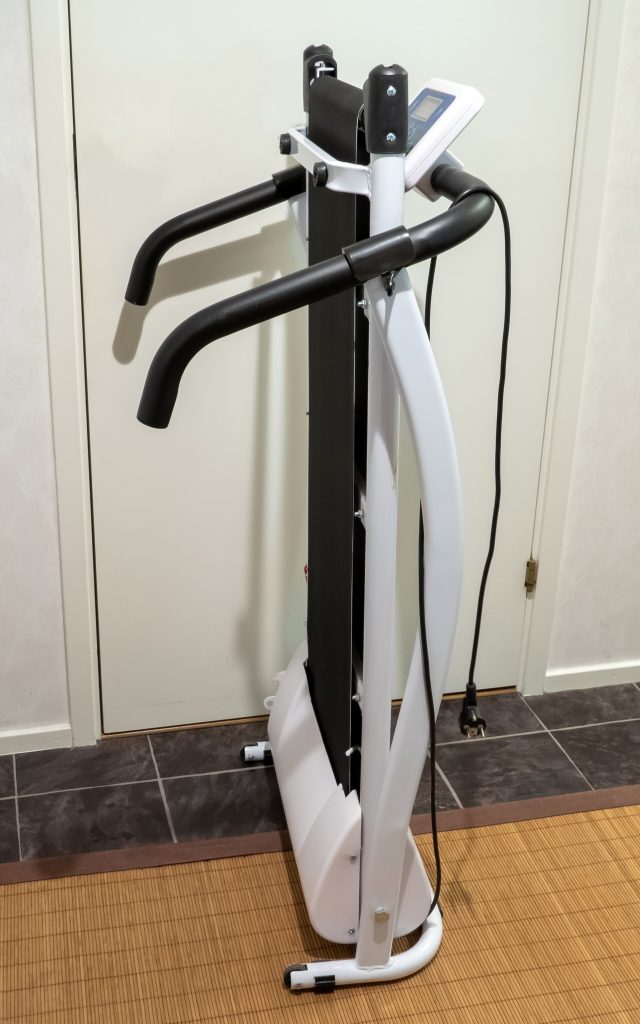
Folding gear is sold as the answer to a small flat, and the label does most of the selling. A machine that folds in half still weighs what it weighs, still needs a place to stand while folded, and still takes two hands and ninety seconds to get back to the wall.
The useful distinction is not folding versus fixed. It is whether the folded state is a genuinely different object, one you can lift with a single hand and park on its edge, or the same object crouched down and waiting to be tripped over.
The four families below are judged on hinge quality, stiffness lost, and handling time, rather than on the word printed on the box.
A hinge folds, a pin does not
A folding mechanism moves around a fixed pivot in one motion, and returns to the same position every time. A mechanism that requires pulling two pins, sliding a collar or removing a bolt is disassembly, and disassembly costs minutes rather than seconds.
That difference decides whether the item gets used on a Tuesday night. Two minutes of assembly is tolerable once a week and corrosive three times a week, especially when the room is shared and someone is waiting for the floor.
Count the steps out loud in the shop or in the video. More than three steps, and you have bought a fixed item with extra parts.
Folding benches and where the joint sits
Two designs get called folding. The first has a solid deck with legs that fold flat underneath, which keeps the pressing surface continuous and the bench stiff.
The second folds the deck in the middle of its length. That puts a hinge exactly where your upper back sits during a press, and any play in it becomes a rocking movement under load rather than a firm base.
The leg-fold design stores to about 20 cm of thickness and takes one hand. The length-fold design stores smaller but behaves like a bench with a soft spot in the middle, which is the worse trade in a room where you will press often.
Wall-mounted racks that swing out
A folding wall rack is the most space-efficient serious option in a small room, because its stored state is 100 to 150 mm of depth against a wall. Nothing else holds a barbell and disappears that completely.
The cost is the wall. The load path runs through the mounting points into studs, and a rack that misses the studs will fail at the plasterboard rather than at the steel. That makes the installation the product, not the frame.
You also need roughly 3 m of clear wall and a floor that can take the drops. Where those two conditions hold, this is the only folding category that beats a fixed equivalent.
Folding treadmills and the deck joint
A folding treadmill hinges the walking deck upward against the console, which halves the floor length and raises the centre of gravity at the same time. Most weigh 60 to 90 kg and roll on front wheels only.
That means lifting the rear of the deck to move it, which needs a clear lane of 1.5 m and enough strength to tilt the mass. The folded state is compact, but it is not light, and it is not a one-hand operation.
The deck joint also adds a flex point under a running gait. Walking tolerates it; running exposes it as a slight give at foot strike, which most owners stop noticing and no owner enjoys.
Folding rowers and the monorail
Rowers fold at the junction between the monorail and the front frame. The monorail is the structural beam that carries your whole bodyweight through the slide, so the hinge is inserted into the most loaded member of the machine.
In practice the joint holds up, because the loads are modest and the engagement is broad. What it does add is a second place for the frame to flex and for the rail connection to rattle, which matters more in an apartment than in a garage.
A folded rower also stands on its nose, roughly 0.5 by 0.6 m of floor and about 1.5 m of height, which is a shape that fits hallways better than corners.
What the joint costs in stiffness
Every hinge is a spring. Even a well-machined one deflects a little, and the deflection is felt as a wobble at the top of a lift rather than seen as a number on a spec sheet.
For most home training the wobble is harmless and the nervous system adapts within a session. For heavy squats and presses it changes the feel enough that people start avoiding the lift, which is a training cost rather than a safety one.
Joints also rattle. Loose play in a folding frame is a repeated metallic click at the bottom of a rep, and in a building with thin floors that click is the thing the neighbour hears.
Folded volume is not stored volume
A folded item takes less floor but rarely less wall. Leaning a folded treadmill or a folded rack against a surface means that surface stops being usable for anything else, and the object needs a keeper to stop it falling.
Most folded machines migrate to a hallway or behind a door, where they sit permanently and become a shelf with a training function. The floor is clear, which was the point, but the object never leaves.
The honest measure is where the item lives when it is not in use, and whether that place already existed. If you have to invent the place, you have invented a new problem.
The one-hand test
Before buying anything with a hinge, picture moving it in the state you will actually store it. If that move needs two hands, a foot and a clear metre behind you, the folded state has solved nothing.
The test has three parts: lift it with one hand, stand it on its edge without it toppling, and put it back without looking. Fail any of the three and the item is fixed equipment wearing a hinge.
Run the test in the shop rather than at home. The folded dimensions on a box describe a shape, not a weight or a balance point, and those are what decide whether it moves or stays put.
When fixed gear is the better folding gear
If an item has a permanent home in the room, the folding version is worse in every dimension: heavier, less stiff, more expensive, noisier. Folding pays only when the room must be restored, and restored daily.
That condition is common in studios and shared flats and rare in a spare bedroom. Matching the mechanism to the room, rather than to the catalogue, is the whole decision.
The lighter answer for many flats is not a folding machine at all but a smaller fixed one: a short bench, a pair of stands, a bar on a wall hook.
Folding solves a storage problem and creates a handling problem, and handling is paid far more often than storage. The next thing worth checking is how many seconds the whole routine really adds, because that number decides adherence more reliably than floor area does.
It also decides what stays out permanently, which is the subject of the tier system that follows.