One Kettlebell or Two: How Wide the Weight Jumps Should Be
 7 min read
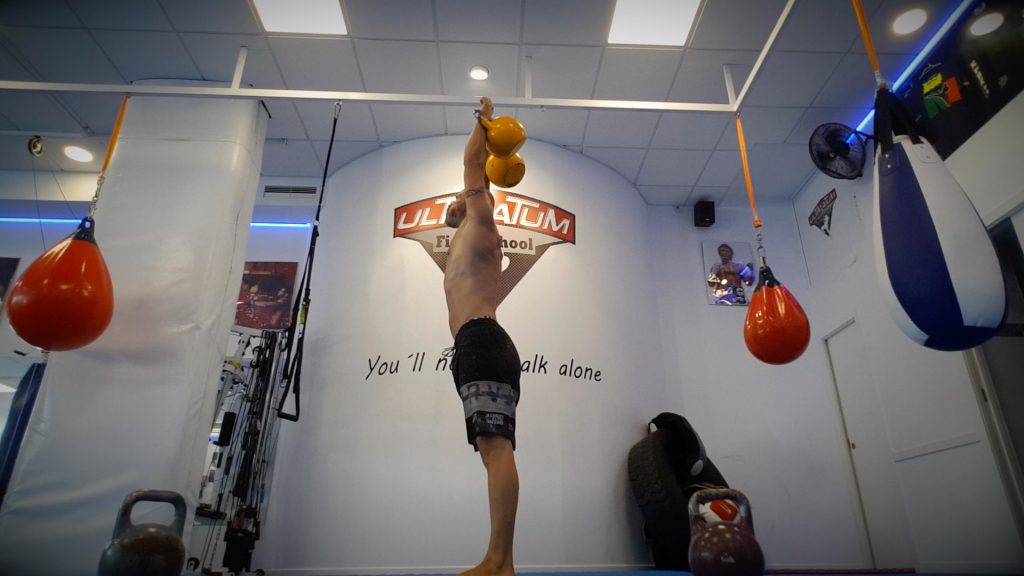
Kettlebell buying advice often starts with a pair, as though symmetry were the point of the tool. It is not. Most kettlebell work is unilateral by design, and a single bell can carry a lifter through years of pressing, swinging, and carrying before a second one adds anything of substance.
The real decision hides two separate questions: whether you need two bells at once, and how coarse the jumps between sizes can be before progress stalls. Those have different answers, and a pair with bad jumps is worse than a single bell with good ones.
The Case for a Single Bell
One bell forces the body to manage asymmetry. A single-arm press, a suitcase carry, and a one-arm swing all ask the trunk to resist rotation, which a pair does not do in the same way. That anti-rotation demand is a training effect in itself, not a workaround.
It also halves the cost of every step up the ladder. Moving from 16 kg to 20 kg costs one purchase instead of two, which makes a fuller range of sizes affordable on the same budget. More sizes with smaller gaps usually beats fewer sizes bought in twos.
Range matters more than count for a different reason. A single 24 kg bell can be pressed for low reps, swung for power, and carried for distance, which covers three adaptations with one purchase. The pair splits those roles across two loads and two payments.
The Case for a Pair
Double work changes the stimulus rather than duplicating it. Two bells in a front rack load the trunk anteriorly and turn the squat and the clean into a bracing problem, which single-bell work rarely reaches. The loading position alone changes what the movement trains.
The cost is that every size now costs double, so most people end up with two or three pairs and large gaps between them. Wide gaps are exactly what a pair is supposed to solve, and the budget usually prevents it. The pair often produces less total work than a single bell plus patience.
Double work also demands more from the grip and upper back before the legs are challenged. That shift in where fatigue lands is easy to miss when the log only records weight and reps. Note where you actually fail, not just how much you moved.
Jump Size in a Typical Ladder
Standard cast bells step in 4 kg increments: 8, 12, 16, 20, 24, 28, 32. At the light end that is a 50 percent jump, and at the heavy end it is under 15 percent, which is an enormous difference in how the same nominal step feels.
The common fix is a competition-style set stepping in 2 kg or even 1 kg. That is precise and expensive, and the precision matters mainly for pressing, where a 4 kg jump at 24 kg is a hard wall. Swings absorb the same jump without noticing it.
Consider what the jump does to technique rather than only to load. A 4 kg step at the top of a press ladder often produces a lean and a shortened range instead of a stronger press, which trains a different movement than the one intended.
Press Versus Swing: Different Tolerances
Ballistics tolerate coarse jumps. A swing or a clean at 24 kg after 20 kg is a modest change in output, and the movement pattern absorbs the difference with little technique drift. Power work is forgiving because the bell is never held at a sticking point.
Grinds do not. A strict press that fails at 24 kg will not be rescued by effort alone, and the gap between 20 and 24 can hold a lifter back for months. If pressing is central to your training, narrow the jumps around the press and let the ballistics follow.
A workable rule is to let the ballistics lead and the grinds follow. Buy the big jumps for swings and cleans, and keep the small ones around whatever weight you can strictly press for five clean reps on each side.
The Skill Cost of Switching Sides
Single-bell work means switching hands, and switching inside a set costs time and attention. In a density block that overhead is real and shows up as fewer reps in the same window. It also interrupts breathing patterns that a pair would leave undisturbed.
It also builds a skill a pair never teaches: maintaining tension while the load moves between sides. Whether that counts as a benefit depends on whether your goals include carryover to uneven real-world loads. For most people it is a small bonus rather than a reason.
There is also a recovery cost to switching. Every hand change is a brief pause in tension, and a long set of snatches becomes a series of small restarts rather than one continuous effort. Density suffers in a way the clock notices.
Storage and Transport
Two 24 kg bells occupy a small patch of floor but weigh enough that moving them is a chore. A single bell can be carried to a park or a garage without a plan. That difference decides how often the equipment leaves the room.
If your training happens in more than one place, a single bell plus a smaller one for warm-ups covers more situations than a matched pair that never leaves the corner. Portability is a training variable, not a convenience.
Where Cheap Bells Fail
Cast iron is forgiving, but handle finish is not. A rough handle tears hands during high-rep swings, and a painted handle becomes slippery once sweat arrives. Both problems appear on inexpensive bells and neither is fully fixable with chalk.
Handle diameter matters as much as texture. A thick handle spreads the hand and limits wrap for anyone with small hands, while a thin one digs into the palm during long sets. Neither is a defect, since each suits a different lifter.
Check the handle thickness and the seam under the bell before buying anything used. A seam that catches a fingernail will catch a callus, and the fix is sanding, which removes the finish you paid for. Handle geometry matters more than the finish itself.
Weight distribution inside the bell matters for the rack position. A bell with a wide, flat base sits better on the forearm than one with a rounded body, and that difference shows up in every clean you perform.
Building a Ladder on a Budget
A workable compromise is one bell at each of three sizes, spaced 4 kg apart, with the middle one bought twice only if double work becomes central. That covers single-bell training fully and double work partially, and it leaves room to correct the gaps later.
Another route is a single heavy bell plus a pair of light ones, which handles power work with the pair and grinds with the single. The shape of the ladder matters more than its completeness, because gaps can be filled and bad jumps cannot.
Resale is easier with common sizes. A 16 kg or 24 kg bell sells within a week, while an unusual 22 kg can sit unsold for months because few lifters program around it. Liquidity is a real property of a size, not a footnote.
The same incremental logic governs barbell loading, where the smallest plate you own sets the resolution of every program you follow afterwards. A ladder with gaps is a program with gaps.
Before buying the next size, it is worth checking how much of a plateau is a strength problem and how much is a jump-size problem.