Adjustable Dumbbells Against Fixed Pairs: Speed, Durability, and the Real Trade
 7 min read
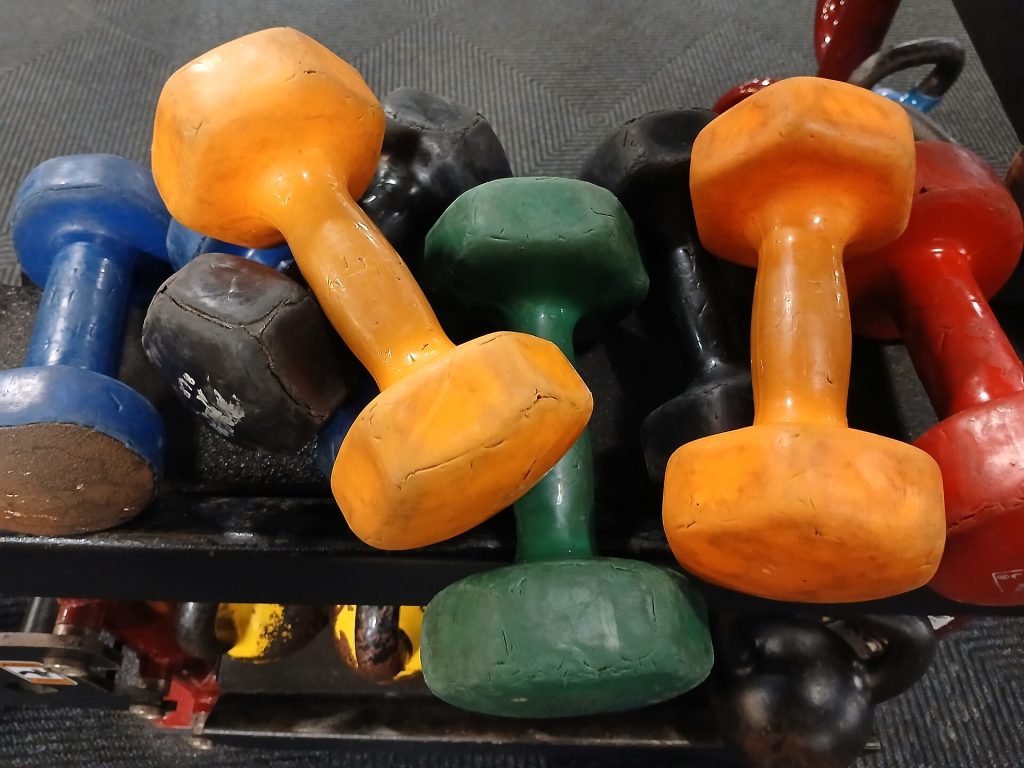
Adjustable dumbbells get presented as the obvious answer for a home gym, as though one pair quietly replaces a wall of fixed weights. That framing hides the actual trade. A good adjustable pair replaces perhaps six fixed pairs, and it takes payment in seconds per set, in handle feel, and in a mechanism that can jam.
The comparison worth making is not adjustable against nothing. It is adjustable against a compact fixed set, and which format wins depends on how many load changes you make inside one session rather than on how much floor space you save. Two lifters with identical rooms can reach opposite conclusions.
How Many Loads You Really Use
Count the weights you touch in a typical month. Most lifters work inside five or six values for pressing, rowing, and lateral work, with a wide gap between the heaviest and lightest of them. That count, not the catalog range, is what decides whether a mechanism is worth owning.
If your working set is that narrow, one or two fixed pairs cover nearly every session with nothing in the way. If you program pyramid sets, drop sets, or ascending ladders, the count climbs fast and the adjustable pair begins to earn its place. Write the list down before shopping rather than guessing.
A second count is worth doing for range rather than frequency. Note the heaviest weight you touched in the last two months for any dumbbell lift, because that single number decides whether the adjustable pair needs to reach 32 kg or can stop at 24 kg and save money.
Changeover Time Inside a Session
30 seconds to change a pair sounds trivial until it lands in the middle of a superset. Rest periods stretch, heart rate falls, and a session that should have taken 50 minutes drifts past the hour. The cost compounds because it lands in the part of the session where fatigue is already high.
The cost is highest in circuits and lowest in straight sets with long rests, where the change hides inside a rest you were taking anyway. That single distinction explains most of the disagreement between lifters who like adjustable pairs and lifters who resent them after a month.
Durability Under Drops and Daily Use
Fixed dumbbells are monolithic. There is no selector, no collar, and no sliding pin, so a drop onto rubber is absorbed by the head and the floor alone. Almost nothing on them can go out of alignment, which is why gyms buy them by the rack and replace them by the decade.
A careful set-down preserves a selector dial for years. A habit of dropping the pair from hip height does not, and the failure tends to arrive as a stuck plate or a skipped increment rather than a clean break you can see. Once a stack skips, every load above it becomes approximate.
Warranty terms deserve a read for the same reason. Most cover the frame and exclude the mechanism, which is the only part likely to break. A five-year frame warranty on a dial-based product is close to meaningless.
Balance and Handle Feel
Fixed heads sit close to the hand, so the mass hangs almost under the wrist with little leverage working against it. Adjustable pairs carry mass in a stack, which pushes the center of gravity outward and makes the same nominal weight feel heavier. The difference is small at 10 kg and obvious at 30 kg.
That difference shows up most on pressing and overhead work, where a wandering center of mass costs stability. It barely matters on rows, carries, and shrugs, where the load path is more forgiving and the hand is not asked to steer. Judge the format against the lifts you actually do.
Handle diameter adds a second variable that catalogs rarely list. A fat handle spreads the hand and reduces wrap, which shows up as grip failure before the target muscle tires. Measure the handle, not just the head, when comparing two pairs side by side.
Footprint, Storage, and Noise
A rack of fixed pairs from 5 kg to 30 kg occupies close to 2 m of wall and puts a serious point load on the floor beneath it. One adjustable pair fits in a corner and can be carried to another room. That portability is the strongest practical argument for the format.
Adjustable pairs also rattle. Loose plates in a stack buzz against each other on every rep, and in an apartment that sound travels through the floor more readily than the thud of a solid head. If noise is a hard constraint, rubber-headed fixed pairs are quieter by a wide margin.
Cost per Kilogram Over 8 Years
Per kilogram, adjustable pairs are cheaper at purchase and more expensive at repair. Fixed pairs run the other way: a higher entry cost, then almost no maintenance beyond a wipe and an occasional check of the welds. The two curves cross somewhere in the middle of the ownership period.
Spread across 8 years, the gap narrows more than either sales pitch suggests. What remains is the resale market, which prices fixed pairs more confidently because there is nothing to inspect except the head, the handle, and the chrome. Adjustable pairs resell on the strength of a mechanism a buyer cannot test in five minutes.
Replacement parts are the hidden line item in that arithmetic. Selector plates, pins, and cradle trays stay available for a few years and then vanish, which turns a repairable pair into scrap. Fixed pairs have no such clock running against them.
The Hybrid Setup Most People Settle Into
A common compromise is a short fixed ladder, three pairs around the working weights, plus one adjustable pair for the outliers. Frequent changes stay instant and rare changes stay possible without a second rack. It also spreads the cost across two purchases instead of one.
It costs more than either pure option, but it matches how dumbbell training actually looks: a few loads repeated often, and a long tail of odd values used once a month. That shape holds across most programs, which is why the hybrid keeps reappearing in home gyms that started with a single pair.
When the Fixed Set Is Simply Better
If your space is permanent, your budget is available, and your loads are stable, fixed pairs win on every axis except storage. There is nothing to adjust, nothing to jam, and nothing to think about between sets. The training becomes slightly duller and slightly more reliable.
The case reverses for renters, for anyone training in a shared room, and for lifters whose working weights move every few weeks as a program advances. Portability and range beat handle feel when the room itself is temporary. Neither format is wrong; one is wrong for a particular room.
Budget matters less here than people expect, because the difference between the two paths across several years is roughly one pair of shoes annually. What is not small is the friction of a format that fights the way you already train.
The same logic applies to barbell loading, where the cost of a change is counted in plates handled rather than in a dial turn. Increment size and changeover time interact in ways that are easy to measure and almost never measured.
Choosing a dumbbell format is really a question about how your sessions are built, and that question is worth answering before any equipment list gets written down.