Doorway Pull-Up Bars: Load Path, Width, and the Damage Nobody Mentions
 7 min read
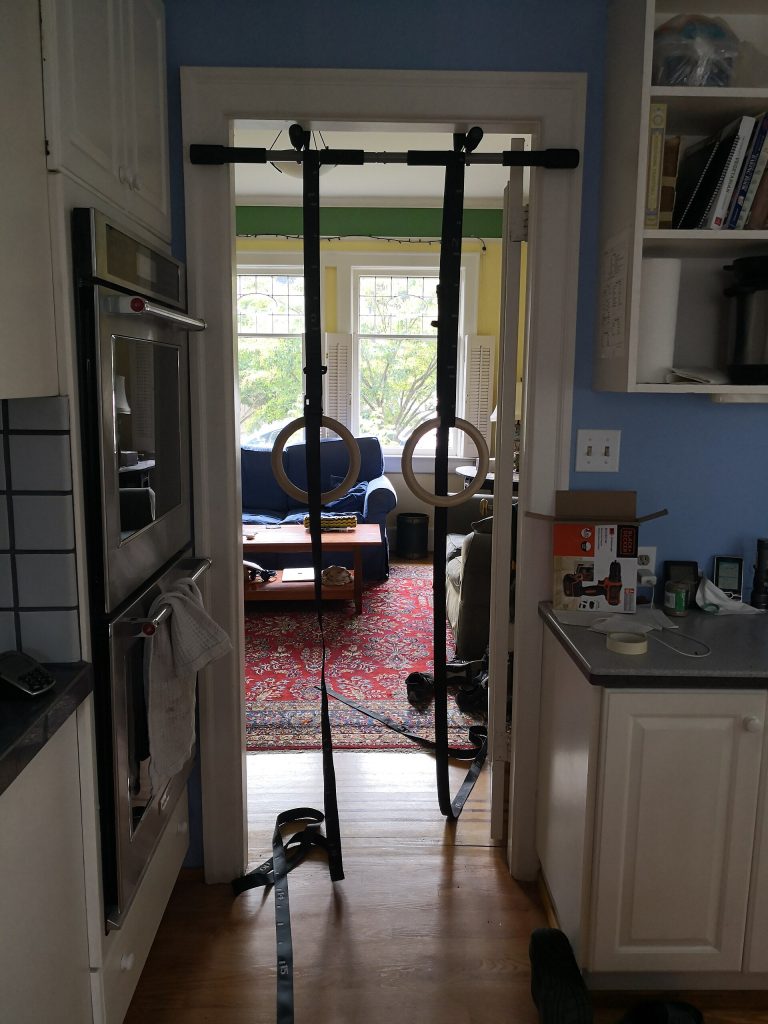
A doorway bar looks like the cheapest route into pulling work, and the usual assumption is that the door frame must be strong because the wall around it is. The frame is typically the weakest part of that assembly and the cheapest part of the room to replace.
These bars hold by wedging. The ends press outward into the jambs, friction plus a little give in the trim holds you up, and the whole arrangement depends on the trim being firmly attached to something structural behind it.
Width ranges, casing condition, leverage and the specific pattern of damage are what separate a bar that survives years from one that takes the door casing with it.
How the load actually travels
At the bottom of a pull-up your bodyweight arrives as roughly 1.3 to 1.5 times bodyweight in dynamic tension, and a kipping rep multiplies that again. The bar converts that vertical pull into two horizontal forces pushing into the jambs.
Those horizontal forces are what hold the bar up, because friction between the rubber pad and the casing resists the downward slide. Take away either the outward pressure or the friction and the bar drops.
This is why the instruction to check the bar before every set is not lawyer language. The mechanism has no positive lock, only a balance of forces.
The casing is decoration, the frame is structure
Door casing is usually 9 to 12 mm of moulded timber or MDF, fixed with a handful of nails into the frame behind. It exists to cover the gap between wall and frame, and it was never designed to carry a person.
The structural members are the jack stud and the header behind that casing. A bar that grips only the casing sends your bodyweight through six nails and a paint film, which is a load path measured in hundreds of kilos through fixings meant for gravity alone.
Solid masonry openings and older hardwood frames behave very differently from a modern drywall return with a hollow jamb. The bar cannot tell the difference, and neither can you until it slips.
Width ranges and the fit problem
Most bars cover openings from about 62 to 92 cm by extending two halves over a centre tube. The pads need full, flat contact on both sides, and the usable range is narrower than the published one in practice.
Rounded or profiled casing turns that contact into a line rather than a face, which cuts friction and concentrates stress on one edge of the moulding. A bar that fits loosely in a wide opening is more dangerous than one that barely fits a narrow one.
If the bar rocks when you hang on it without pulling, the pads are not seated. That rocking is the failure mode announcing itself early.
Leverage and why long bars hurt frames
Grips sit inboard of the jamb, so your hands are always offset from the support point. That offset creates a bending moment on the casing, and the moment grows with the distance between the grip and the pad.
Wide-grip bars therefore load the frame harder than narrow ones at the same bodyweight, and a bar whose grips sit far outboard is effectively a lever aimed at the top corner of the casing.
The stored energy in a flexing bar adds a second effect: it bends under load and springs back, so the pads work against the jamb rather than simply resting on it.
The damage signature
Failure is rarely dramatic. It starts as a hairline crack in the paint along the mitre where the side casing meets the head, then the casing pulls a few millimetres off the wall at the top corner.
From there the head casing sags, the door starts catching, and the repair is no longer cosmetic. A deposit deduction for a split casing is small; one for a dropped header is not.
Because the progression is slow, the damage is usually discovered at move-out rather than at the moment it began, which is the worst possible time to argue about who caused it.
Door swing, head clearance and the working position
The bar sits around 1.9 to 2.1 m, so the door has to be either fully open or fully closed and stay that way during the set. A door that drifts under vibration will unload one pad.
Head clearance above the bar matters as much as the bar height. A ceiling or a bulkhead 30 cm above the bar turns a pull-up into a crouch, and most people only notice after installing.
You also need about 60 cm of clear floor on the working side, which in a hallway means the bar is only usable when nobody needs to walk past.
When the frame is genuinely strong enough
Older openings with solid timber frames, deep casings and a header directly above are the good case. So are masonry walls with a genuine rebate, where the pad bears on something that does not flex.
The bad case is a plasterboard wall with a thin return, a softwood jamb and casing fixed with brads. It will hold for a while, which is precisely what makes it dangerous.
A five-minute check with a magnet to find the fixings, and a firm push on the casing with your thumb, tells you more than any load rating printed on the bar.
Alternatives that do not touch the trim
A freestanding tower takes about 1.2 by 0.9 m of floor and wobbles under fast reps, but it puts zero load into the building fabric and folds away in most designs.
A ceiling mount fixed into joists above the doorway is stronger than any wedging bar and completely invisible when unclipped, at the cost of a drill and a joist finder.
A strap thrown over a structural beam works in lofts and basements, and rings hung from it add a movement the bar cannot offer.
Rattle, the door, and the corridor outside
A doorway bar adds a metal tube and two rubber pads to an assembly that already creaks. The door rattles in its frame during a set, and that rattle carries into a corridor far better than the movement itself does.
The frame is the weak point acoustically as well as structurally. A door with a 10 mm gap beneath it is a hole in the wall, and sound travels through gaps rather than through the panel.
Closing the door and rolling a towel along the bottom costs nothing and cuts what the corridor hears. It does not help the flat below, which is a floor-path problem rather than an opening problem.
Where the bar hangs in a shared hallway the noise is also a social cost. Every set announces itself, and what irritates people is the reminder that someone else is using the space, not the decibels.
Any of these can be removed at the end of a tenancy with a tube of filler, which is the standard a renter should hold every fixing to. The next question is how long the whole setup takes to put away, because that number, not the load rating, decides whether the bar gets used in February.
Handling time is also what makes a shared doorway awkward, which is worth working through before the bar goes up.