Ventilation and Humidity in a Garage Gym
 7 min read
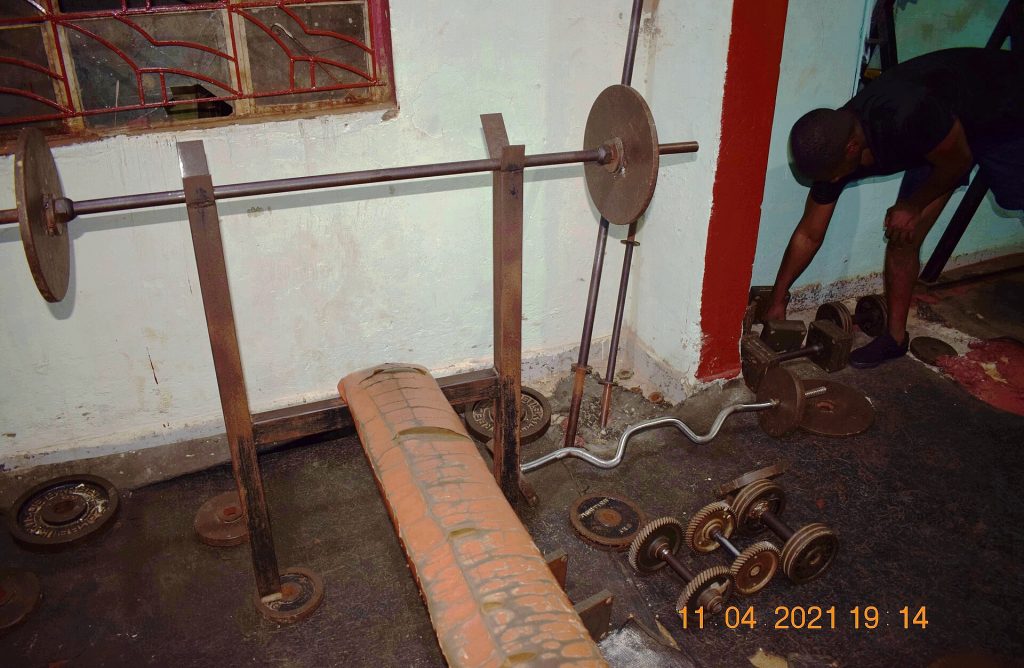
Opening the garage door for a few minutes is not ventilation, though it feels like it. A door opened after training removes the smell and leaves behind the moisture, the dust and the solvent vapour that were the actual problem.
A garage is a concrete box in contact with the ground, often uninsulated and rarely fitted with mechanical ventilation. It runs colder and damper than the house, and every piece of steel inside it becomes a condensation surface for part of the year.
What follows compares strategies rather than products: cross flow, a single extractor, a dehumidifier, and doing nothing at all. Each suits a different climate, and each carries a monthly cost as well as a purchase price.
Why a Garage Behaves Differently
Three things separate a garage from a room in the house. The slab sits on or near the ground and stays cool through spring, the door is large and poorly sealed around its edges, and there is usually no heating beyond whatever a portable unit provides when someone remembers to switch it on.
A cool slab plus warm moist air equals condensation on the floor and on anything touching it. That is why the underside of a rubber mat is wet in spring while the air above feels dry, and why bars stored on the floor rust at the contact points.
Cars bring water in as well. A wet car parked overnight adds litres of moisture to the air, which then condenses on cold steel. A gym sharing space with a wet car is a harder problem than a gym in a clean garage.
Relative Humidity Is a Misleading Number
Relative humidity is a ratio, not a quantity, so the same reading means different things at different temperatures. Air at 70 percent and 5 C holds far less water than air at 70 percent and 25 C, which is why a cold garage can read as damp while holding very little actual moisture.
This matters because a heater appears to fix humidity. Warm air holds more moisture, so the percentage falls while the water stays in the room and condenses on the first cold surface it meets, usually the slab or a plate.
A cheap hygrometer and a thermometer together give a better picture than either alone. Watching both shows whether a room is damp or merely cold, and those two problems have quite different solutions and different price tags.
Cross Flow Beats a Single Fan
A fan moving air inside a closed box does not ventilate, it stirs. Air has to enter somewhere and leave somewhere else, and the exchange rate depends on the openings rather than on the fan’s rated output.
Two openings on opposite sides, ideally at different heights, produce far more exchange than one large opening. A high vent and a low vent exploit the stack effect, where warm air leaves at the top and cooler air enters below.
A single extractor works if it has a path to draw from. Sealing the room and running a fan lowers the pressure and reduces the flow, which is a common reason a noisy fan achieves nothing measurable.
The Dehumidifier Arithmetic
A dehumidifier removes water, which is the only thing that actually solves condensation. Capacity is rated in litres per day at a stated temperature, and that rating collapses in a cold garage, often to half or less.
The unit also adds heat, welcome in winter and unwelcome in summer. Running one in a sealed garage for a few hours a day is usually enough to hold steel above the dew point, provided the room is not being flushed with damp air.
Drainage decides whether it gets used. A unit that needs manual emptying fills at the worst moment, so a hose to a drain or a small condensate pump turns an annoying appliance into a background one.
Rust: Where It Actually Starts
Rust rarely starts on the visible face of a bar. It starts in the knurling, under tape, at the sleeve interface and on the underside of plates stacked on a damp floor, where air movement is lowest.
Plates stored flat on concrete wick moisture across the whole contact face, which is why a rack or a wall horn is a corrosion measure as much as a storage one. Anything that lifts steel off the slab pays for itself.
A light oil film and a dry environment do more than any coating. The rule is simple: keep the steel dry, keep air moving, and inspect the places you cannot see, which are exactly the places that fail first.
Floor Coverings That Trap Water
Rubber mats are the standard gym floor and a moisture trap in a garage. Water condenses on the cold slab beneath, cannot escape through the mat, and stays there for months, rusting whatever sits on top of it.
Lifting the mats periodically to dry both surfaces is the practical fix, which means mats that can be moved rather than glued. Interlocking tiles are worse than heavy rolls here, because water collects in every joint between them.
A raised platform with an air gap is better still, and it doubles as a decoupling layer for impact noise. The cost is height, roughly 100 mm, which matters under a low ceiling or beneath a garage door track.
The Closed-Door Season
Winter changes the problem from heat to air quality. A sealed garage containing a car, a heater and a person accumulates carbon monoxide and moisture, and neither is obvious without a monitor of some kind.
Any fuel-burning heater in a garage needs an air supply and, ideally, a detector. Electric heaters avoid the combustion problem but not the moisture one, and they dry the air in a way that feels better than it is.
The practical routine is short and unglamorous: ventilate after sessions, keep the slab dry, run a dehumidifier in the damp season, and store steel off the floor. Most rust problems are solved by the last item alone.
Air Quality, Dust and Chalk
Chalk is a fine particulate that settles on everything and stays airborne long enough to be breathed. In a garage it mixes with concrete dust, tyre rubber and whatever the car brings in, which is a poor combination for a room where people breathe hard.
A vacuum with a fine filter and a covered chalk bowl reduce the load more than an air purifier does. Purifiers help, but they treat the symptom while the source keeps producing dust through every session.
Sweeping is the worst method, because it lifts fines back into the air. Damp sweeping or a vacuum is the cheap upgrade, and it takes less time than the sweeping it replaces once the habit exists.
Where This Leads
Ventilation and humidity are two halves of the same problem, and both are usually solved by small habits rather than by equipment. The larger question is what the room does to the equipment over several years of use.
That question leads to storage, since the parts that fail first are the parts that touch the floor. Lifting bars and plates off a cold slab costs less than replacing them, and it changes nothing about how the room trains.