Rubber, Foam, Carpet or Bare Concrete: Picking a Gym Floor
 7 min read
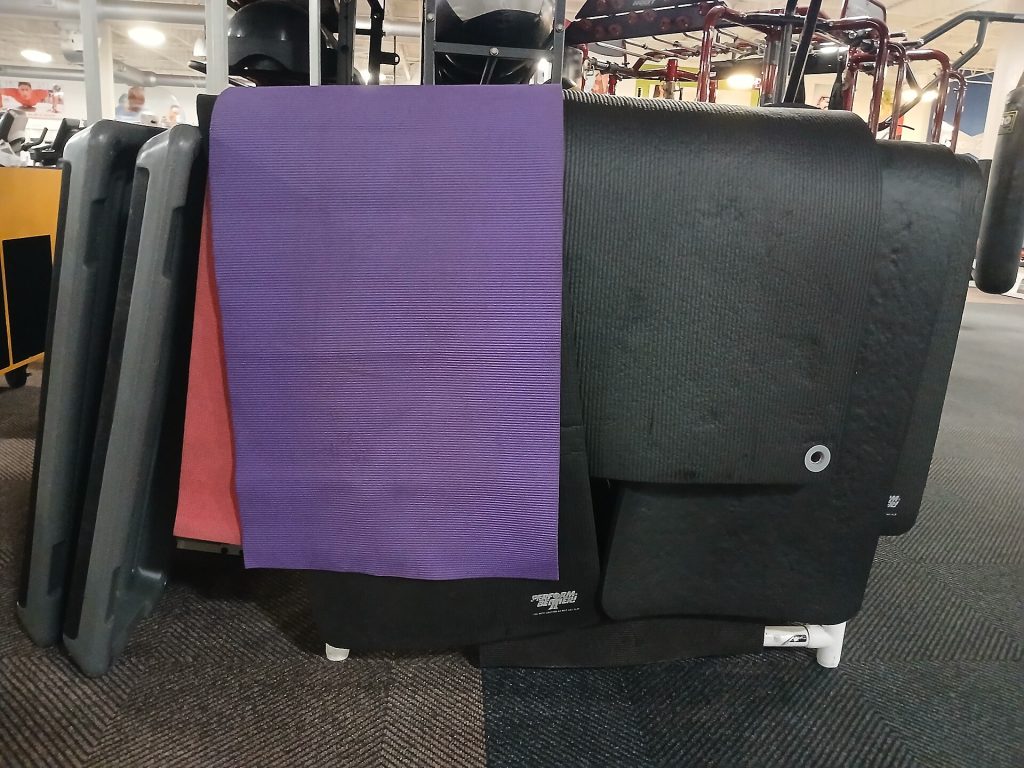
A gym floor is not mainly about comfort, despite the way mats are sold. It has three jobs at once: protect the substrate, absorb what gets dropped, and keep the surface predictable under a foot that is moving a loaded bar.
Those jobs pull against each other. A surface soft enough to cushion a dropped dumbbell is too soft to squat on, because the foot sinks and the ankle loses its reference. Stiff enough to lift on, and impact passes straight through to the slab and the room below.
This comparison covers bare concrete, rubber in its two common forms, foam tiles and carpet. For each, the questions are the same: what does it protect, what does it cost in stability, and what happens when it eventually has to come out.
What the Floor Is Actually Protecting
Three things sit under the mat, and each tolerates a different amount: the slab or deck takes point loads from rack feet and dropped plates, the equipment takes impact through its frame and welds, and your joints take whatever passes through both.
A floor that fails the slab test shows up as cracks radiating from rack feet, or a hollow sound under a tile. A floor that fails the equipment test shows up as flat spots and loose hardware. Both failures are slow, and both are expensive to reverse once they start.
The fourth job is sound, which is ignored until someone complains. Absorbing impact inside the room and stopping vibration from entering the structure are different tasks, and only the first of them is solved by a mat of any thickness.
Bare Concrete as the Baseline
Concrete is the stiffest and cheapest surface available, and it is the best one to squat on. There is no compression, so the foot stays where it is put and the bar path stays repeatable. It is also cold, dusty and unforgiving to anything dropped.
Dust is the practical problem. Untreated concrete sheds fines that migrate onto bars, into bearings and onto your hands, and a sealer is the fix. Sealed concrete is slightly slick, so a textured product or a mat in the working zone is still needed.
The compromise most people reach is bare concrete outside the working area and a mat inside it. That works, provided the mat is dense enough not to slide and the edge is fixed rather than left as a trip hazard in the dark.
Rubber: Density Is the Argument
Rubber comes in two families that behave nothing alike. Crumb tiles are bonded granules, cheap, light and prone to compressing over a year of loaded use. Vulcanised rolls are dense, heavy and expensive, and they barely deform at all.
Density decides both stability and protection. A soft tile under a squat behaves like a foam pad, letting the foot sink and the ankle drift. A dense tile protects the slab without changing the lift, which is why commercial floors use the heavy product and homes often do not.
Weight is the hidden cost. Fifteen millimetres of dense rubber runs around twenty kilograms per square metre, so a small room can add several hundred kilograms to a suspended floor before any equipment arrives on it.
Foam Tiles: The Puzzle Floor
Interlocking foam is sold as gym flooring and is really play-area flooring. It is light, cheap and pleasant for floor work, and it separates under any lateral load, which is exactly what a bench and a squat stand apply when someone sits down heavily.
Foam also takes a permanent set. The tiles under a bench’s feet compress and stay compressed, so the surface becomes uneven precisely in the places that carry load. Under a barbell the effect is worse, because the load is concentrated on four small areas.
It has a legitimate role as a top layer over a hard, flat substrate in a room used mostly for stretching, kettlebells and bodyweight work. In that role the cheapness is not a compromise, it is the entire reason for choosing it.
Carpet: The Compromise Nobody Defends
Carpet is warm, quiet and gives good grip for bare feet, which is why it survives in spare rooms. It also holds chalk, sweat and dust, and it compresses unevenly under a bench in a way that never fully recovers.
The structural problem is what sits beneath it. Carpet over concrete is a soft layer on a hard one, so a dropped bar punches through the pile and concentrates force on a small patch of slab. Carpet over timber is springy enough to disturb a heavy squat.
There is one reasonable case: a carpeted room used for dumbbells and bodyweight only, with a dense mat laid over the carpet in the working zone. The mat must be heavy enough to lie flat, or the carpet underneath will wrinkle and the mat will walk.
Thickness, Coverage and the Drop Zone
Thickness is usually chosen by feel, which is the wrong method. Eight millimetres of dense rubber is enough for dumbbells, fifteen for a rack and a bench, and twenty-five or more where a bar is designed to be dropped repeatedly from overhead.
Coverage matters more than thickness. A mat under the rack alone means the bar lands half on rubber and half on concrete, and the edge becomes a lever. Covering the whole bar path, including the walk-out and the landing zone, is cheaper over a few years.
A platform solves the same problem differently, layering timber and rubber to spread load and add mass. It is more work to build and easier to remove, which makes it the better answer in a rented space or above a neighbour.
Edges, Smell and Removal
Rubber smells of rubber for weeks, and the smell is stronger in a warm room with the door shut. Off-gassing fades, but in a garage it can persist through a whole summer, which is worth knowing before covering thirty square metres of floor.
Edges are the durability question. Loose-laid tiles lift at the corners under a foot that pivots, and glued rolls do not. The trade is that adhesive makes removal destructive, taking the surface of the concrete with it when the floor eventually comes up.
Ramps and edge trims cost little and prevent most complaints. They also stop the bar catching on a raised lip, which is the sort of small failure that bends a plate edge or turns an ankle on the way to the rack.
A Two-Layer Floor for Mixed Use
Rooms that serve two purposes rarely suit a single product. A dense rubber layer for the lifting zone plus a thin foam area for floor work gives each activity the surface it needs, at the cost of an edge between them.
That edge is the design problem. A gradual transition strip solves it, while a butt joint between two thicknesses creates a line that a bar can catch and a foot can trip on. Height differences under 5 mm are tolerable; anything more needs a ramp.
What This Leads To
Whatever goes down, the room below is a separate problem. Impact noise travels through the structure rather than through the air, and a mat chosen for comfort does very little to stop it. Decoupling the floor from the building is a different purchase with a different price.
Humidity belongs in the same conversation, because most of these materials trap moisture against a slab. A sealed room with a damp floor is a good environment for rust, and rust is where the next set of decisions usually begins.