Putting a Treadmill in an Apartment: Floor Load, Impact Noise, and Mats
 7 min read
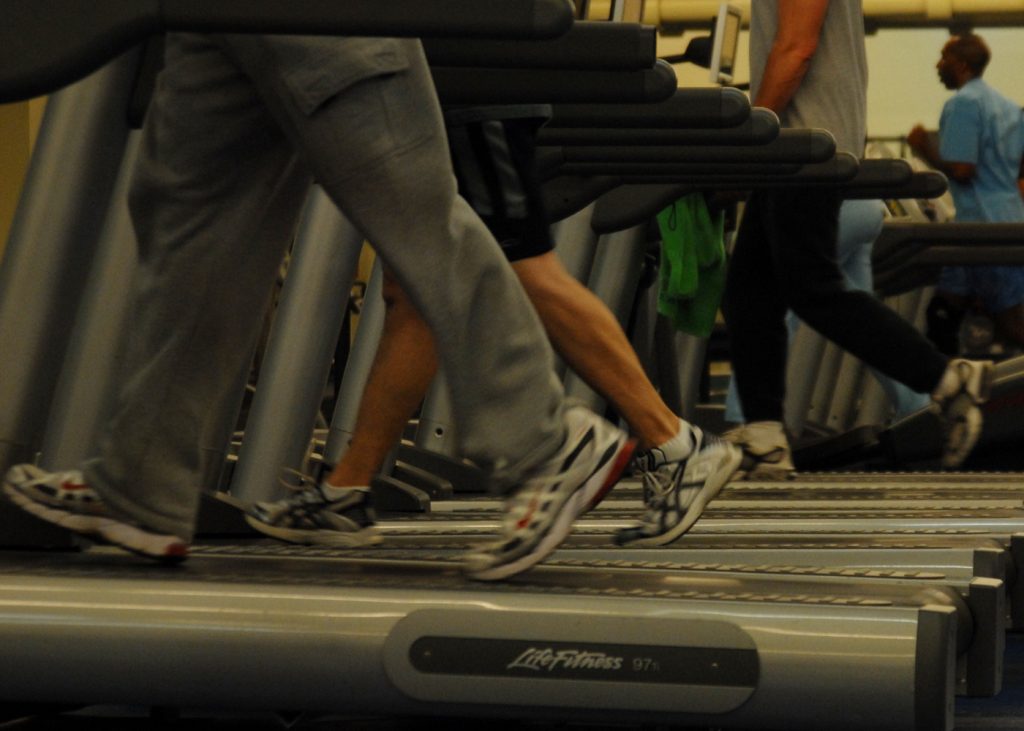
A rubber mat under the machine does not solve the neighbour problem, and the belief that it does is why so many treadmills are listed for sale within a year. A mat addresses one of three separate transmission paths, and in most buildings it is the least important of the three.
The three paths are static load on the slab, structure-borne vibration from footfall, and airborne noise from the belt and motor. Each has a different fix, a different cost, and a different failure mode. Buying the machine before solving them is the usual order, and it is backward.
What follows separates the load question from the acoustic question, because the two are routinely confused and their answers point in opposite directions.
What the Machine Weighs, Loaded
A home treadmill typically runs between 70 kg and 120 kg, and the user adds another 60 kg to 100 kg on top of that. The footprint spreads the total across four feet and two rails, so the static pressure is unremarkable for any floor built for habitation.
The number that matters is not the average but the peak. A runner landing at 12 km/h can produce a vertical force several times body weight for a fraction of a second, and that peak is what the slab, the joists, and the neighbours below actually feel.
This is why two machines of identical weight behave differently. A long, compliant deck spreads the impulse over more milliseconds, while a short stiff deck delivers a sharper spike into the frame and the floor.
Point Loads and Timber Joists
Concrete slabs do not care about a treadmill. Suspended timber floors do, but not because of total weight. Joists deflect under cyclic point loads, and a machine placed mid-span on a long span will flex the floor enough to radiate sound into the room below.
Moving the machine against a load-bearing wall and across the joists rather than along them typically reduces both deflection and transmitted noise more than any accessory you can buy. That is free, and it is the step most people skip on the day the delivery arrives.
Older buildings with shallow joists and no acoustic layer are the worst case. There, the floor itself is the loudspeaker, and no amount of material under four small feet will stiffen it. Rugs and underlay change the sound inside the room, not the deflection of the joists below it.
Where Impact Noise Is Generated
Footfall noise starts at the deck. Every step compresses the deck against its cushioning, and the deck transmits that impulse into the frame, then into the feet, then into the floor. The belt and motor add a steady hum, but the impulse is what generates complaints.
Deck cushioning helps the runner’s joints and does surprisingly little for the room below, because the impulse travels through the frame regardless of how soft the deck feels. Buyers usually discover this after the mat, the platform, and the deck have all been upgraded and the complaint has not changed. This is the point where buyers discover that a softer deck is a comfort feature rather than an acoustic one.
The heel strike is the loudest event, not the heaviest. A light runner landing flat-footed can transmit more low-frequency energy than a heavier runner with a rolling gait, which is why body weight alone predicts very little.
Decoupling the Frame From the Floor
Mass and isolation do different jobs. Adding mass to the assembly lowers the resonant frequency and reduces how much the floor moves. Isolation separates the machine from the floor so vibration has to cross a compliant layer before it arrives.
Isolation only works if the layer is soft enough to deflect under the actual load and thick enough to stay out of contact at the edges. A stiff pad that barely compresses behaves like a rigid extension of the floor and passes nearly everything through unchanged.
The practical consequence is that a heavy machine on a thin pad is usually quieter than a light machine on a thick one, which inverts the advice most buyers receive at the counter.
What Mats Do and Do Not Absorb
A closed-cell foam mat of 8 mm to 12 mm protects the floor finish, damps a little high-frequency noise, and does almost nothing below 100 Hz. Since footfall energy sits largely in that lower band, the mat’s contribution is small but not zero.
Rubber crumb tiles of 20 mm to 30 mm do better, but only when the machine’s feet sit on them without the frame bridging the edges. A mat that is too small lets the frame contact the slab directly, which is the same as having no mat at all.
Layering changes the result again. A dense rubber tile under a softer foam tile tends to outperform either alone, because the two materials respond to different frequency bands rather than duplicating each other’s work.
Airborne Noise and the Room Itself
Belt hum, motor fan noise, and the sound of feet on the deck radiate into the room and then through the walls. This path responds to absorbent surfaces, sealed doors, and distance, not to anything placed under the machine.
Hard rooms with bare walls and laminate floors amplify it. A rug, soft furnishings, and a closed door change the level more than an expensive platform does, which is why the cheap fixes are worth doing first.
The motor adds a tone that rises with speed, and that tone is what makes a treadmill audible through a wall even when the impact noise has been controlled. It cannot be isolated with a mat either, and nothing short of mass in the wall changes it.
Building Rules and Hours
Most leases restrict impact noise to daytime hours and some prohibit exercise machines outright. Reading that clause before purchase is unglamorous and decisive, because a machine you can only use between nine and five is a different purchase than one you can use at seven in the evening.
Runners who train at fixed early hours should weigh that constraint more heavily than the specification sheet. The best machine for a building is the one whose schedule matches yours, not the one with the longest warranty.
Where the rules are ambiguous, a short conversation with the neighbour below is worth more than a week of research. Their tolerance, and their shift pattern, determine what you can actually run.
When the Treadmill Is the Wrong Machine
If the floor is suspended timber, the room sits above a bedroom, and the household trains before seven, no accessory arrangement makes a treadmill a good neighbour. The honest alternatives are a rower, a bike, or a gym membership for the hard sessions.
That is not a defeat. It is a constraint doing its job, and it usually points toward a machine that loads the floor less and produces a less impulsive noise signature. The training effect of a hard bike interval is not meaningfully worse than the treadmill equivalent.
Once the machine is chosen, the next question becomes wear and adjustment: belts stretch, decks wear through, and a misaligned belt is both a maintenance cost and a new noise source. Tracking those intervals is a separate discipline from buying the thing.